
She Painted on Walls. Then on the World.
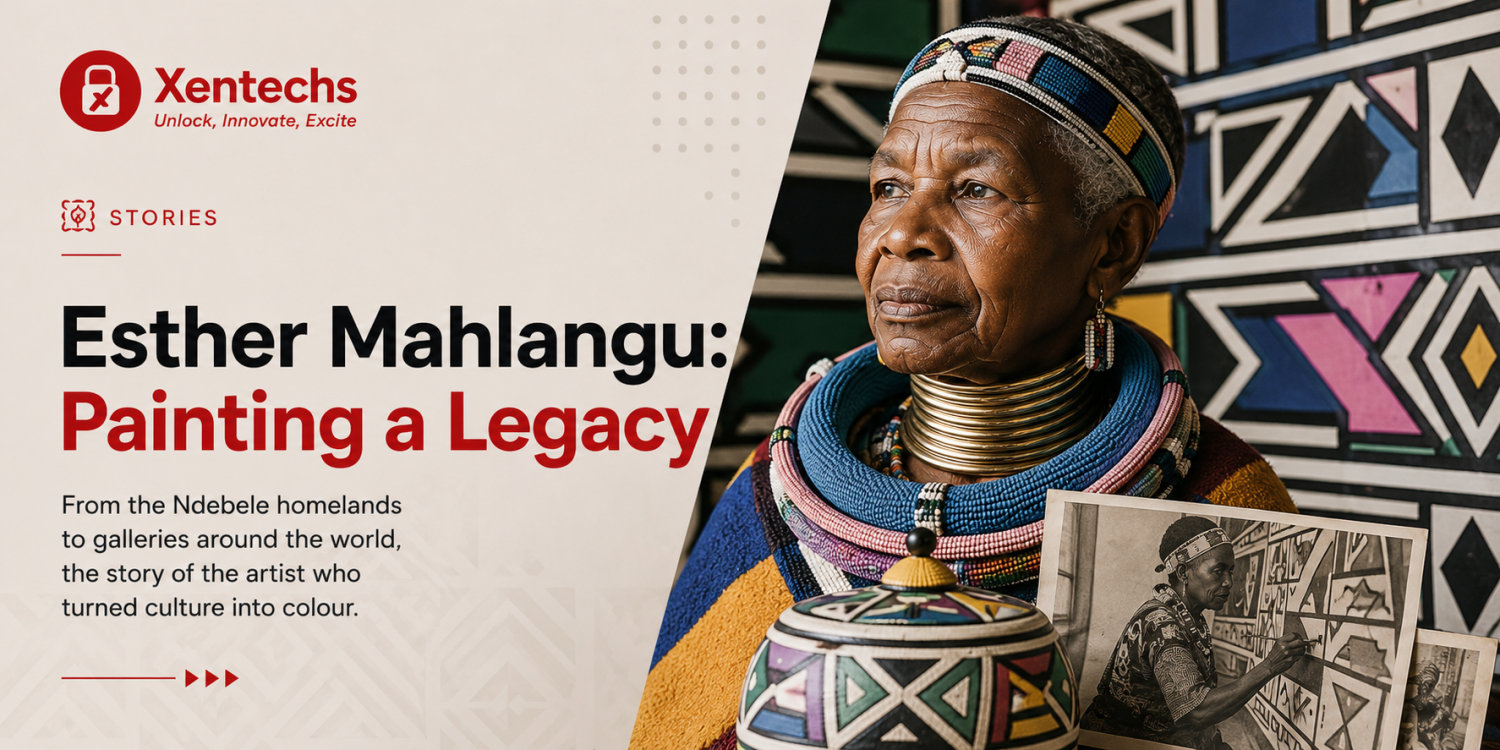
There is a sign outside a house in Mabhoko Village, Mpumalanga, that has been there for years. Hand-painted. Four words. It reads: ESTHER IS HERE. Beneath those words, a self-bestowed title: The 1st woman who visited overseas. ART WOMAN.
It is the most understated description of one of the most consequential artistic careers in South African history. Esther Mahlangu — Mama Esther, as she is known throughout the country she has represented to the world — did not attend formal school. She was taught to paint by her mother and grandmother on a farm outside Middelburg in the Mpumalanga province, beginning at the age of ten, in accordance with a tradition that Ndebele women had maintained for generations.
She has since painted the halls of the Centre Pompidou in Paris. The tail fins of British Airways aircraft. A BMW Art Car that was exhibited at the National Museum of Women in the Arts in Washington D.C. and the British Museum in London. A five-storey mural for the Johannesburg Civic Theatre. A Rolls-Royce Phantom. And in 2024, she collaborated with BMW to create the i5 Flow Nostokana — a concept car whose colour-changing exterior carries her Ndebele designs rendered in E Ink technology.
She did all of this using the same visual language her grandmother taught her. And she has never once left it behind.
"My mother and grandmother taught me to paint when I was ten years old. I have been busy with it ever since and have always liked it. When I am painting my heart is very wide, it reaches out. It makes me feel very, very happy."
— Esther Mahlangu
What the Ndebele Knew That the World Had to Learn
To understand Esther Mahlangu, you must first understand what she carries. The Ndebele people of South Africa — primarily settled in Mpumalanga and Limpopo provinces, with communities extending into Zimbabwe — developed one of the most visually distinctive artistic traditions on the African continent. Their geometric wall paintings, beadwork, and ceremonial dress constitute a visual language so precise and so codified that it took decades for the global art world to begin understanding its depth.
Ndebele painting was not decoration. It was identity, communication, and resistance — simultaneously. The tradition of painting the exterior of Ndebele homes with bold geometric patterns emerged in the 19th century, becoming particularly important as the Ndebele people were dispossessed of their land through colonial conquest and, later, the systematic destruction of apartheid. As they lost territory, they held their culture in their hands — literally painting it onto every surface they occupied.
Ndebele wall paintings were almost exclusively executed by women. Through their paintings, women became socially visible and came to be seen as guardians through which Ndebele identity was maintained across generations — especially in the absence of men, who were pushed into migrant labour in cities and on farms. The patterns carried news of the community, marked life transitions, and declared belonging when belonging had been violently disrupted.
The patterns were not sketched first. They were drawn freehand — using fingers, chicken feathers, and bundled twigs — from memory and from a visual vocabulary inherited across generations. The geometric forms were precise to a degree that later astonished computer scientists and mathematicians who attempted to analyse them digitally. The colours told their own story: originally made from clay, cow dung, and soil, they evolved with the introduction of commercial paints to include the bold, high-contrast combinations — red, blue, gold, green, black, white — that became the Ndebele signature known around the world.
Esther Mahlangu did not invent this tradition. She inherited it, mastered it, and then carried it further than anyone before her had imagined possible.
Traditional Ndebele wall painting · Mpumalanga, South Africa · The geometric visual language Esther Mahlangu learned at age ten from her mother and grandmother
The Farm. The Training. The Beginning.
Esther Nikwambi Mahlangu was born on 11 November 1935 on a farm outside Middelburg in what is now the Mpumalanga province. She was the eldest of nine children. She did not attend school — formal education was not accessible in the way or place she grew up. What she received instead was the education that mattered most to her community: her mother and grandmother sat with her and taught her to paint.
She practiced. Constantly. She watched the older women and imitated what she saw. She painted over and over until her hand moved with the certainty of someone who does not need to think about what the brush is doing — only about what it means. By her teenage years she was already executing murals of considerable complexity, and with the introduction of wider ranges of commercial acrylic paint in the 1940s, her palette expanded alongside her technical capability.
She married and had three sons. She lost her husband and two of her children. She kept painting.
Between 1980 and 1991 she was a resident at the Botshabelo Historical Village in Middelburg — an open-air museum dedicated to preserving and presenting Ndebele culture. It was there that her work began attracting attention beyond the immediate community. And it was there that the chain of events began that would take her, for the first time in her life, onto an aeroplane — bound for Paris.
Paris. The Pompidou. The Moment Everything Changed.
In 1986, researchers from the French Embassy — including associate curator André Magnin, who was helping to document traditional arts globally for a major exhibition — travelled through South Africa. They saw the paintings on Esther Mahlangu's home at Botshabelo. They invited her to participate in what would become one of the most significant exhibitions in the history of contemporary art.
Magiciens de la Terre — Magicians of the Earth — opened at the Centre Pompidou and the Grand Halle de la Villette in Paris in 1989. It was the first major international exhibition to place artists from the Global South on equal footing with established Western names. Esther Mahlangu travelled to France, stayed for two months, and painted a house in front of thousands of spectators. She decorated a wall inside the Angoulême Museum of Fine Arts. She showed her work across multiple French venues.
That first aeroplane flight — from a farm in Mpumalanga to the Centre Pompidou in Paris — was not just a journey across geography. It was the moment the global art world was formally introduced to Ndebele painting. And the world did not forget it.
The BMW Art Car — And What It Meant
In 1991, a phone call came that would become one of the most significant moments in South African art history. BMW — which since 1975 had commissioned artists of international stature to create Art Cars — invited Esther Mahlangu to join the programme.
The list of previous BMW Art Car artists reads like a survey of 20th century Western art: Alexander Calder, Frank Stella, Roy Lichtenstein, Andy Warhol, David Hockney. Esther Mahlangu would be the first non-Western artist in the programme. And the first woman.
She was brought to Johannesburg to work on a BMW 525i. She painted it over two weeks — freehand, using chicken feathers as brushes, in the Ndebele geometric style she had been practising since childhood. It was the first time she had ever painted on a surface that was not a wall.
The timing was not coincidental. BMW had opened a plant in Rosslyn, South Africa, five years earlier. The commission came one year after Nelson Mandela was released from prison, as apartheid legislation began its long unravelling. The car was intended to mark this critical juncture in South African history — and Esther Mahlangu's geometric patterns, bold and uncompromising, became the visual emblem of a nation attempting to declare itself to the world in its own terms.
"Acknowledged within South Africa as a living legend, Esther Mahlangu came to embody the ideals of her homeland in its immediate post-Apartheid period in a way unmatched by her fellow South African artists."
— Frieze Magazine
The BMW 525i was exhibited at the National Museum of Women in the Arts in Washington D.C. in 1994. It was shown at the British Museum in London as part of the exhibition South Africa: The Art of a Nation from October 2016 to February 2017. It remains one of the most recognised objects in the BMW Art Car collection.
A Life of Firsts — The Timeline
1935
Born on a farm outside Middelburg, Mpumalanga. Eldest of nine children.
1945
Begins painting at age ten, taught by her mother and grandmother in the Ndebele tradition.
1980
Botshabelo Historical Village. Becomes a resident at the open-air museum of Ndebele culture. Her work begins attracting international attention.
1989
Centre Pompidou, Paris. Takes her first aeroplane flight to participate in Magiciens de la Terre — the most significant international survey of non-Western contemporary art. Global recognition follows immediately.
1991
BMW Art Car. Becomes the first non-Western artist and first woman to design a BMW Art Car. Paints a BMW 525i using chicken feathers over two weeks in Johannesburg.
1992
Johannesburg Civic Theatre. Commissioned to paint a five-storey mural — one of the largest public art commissions in South African history.
1997
British Airways. Commissioned to paint the tail fins of multiple aircraft with Ndebele designs. Her work begins flying across the world — literally.
2003
First solo exhibition in South Africa. Critical reception confirms her position as the country's most significant living artist in the traditional arts category.
2006
Order of Ikhamanga (Silver). South Africa's highest honour for excellence in arts and culture, awarded by the Presidency.
2018
Honorary Doctorate, University of Johannesburg. Recognised for her legacy as a cultural entrepreneur and educator. A second honorary doctorate followed from the University of Pretoria.
2020
Rolls-Royce Phantom. Paints a bespoke interior for a Rolls-Royce Phantom exhibited at Frieze Art Fair, London. Her work sells for over R2 million at Sotheby's.
2024
BMW i5 Flow Nostokana. Collaborates with BMW to create a concept car featuring a colour-changing exterior adorned with Ndebele designs rendered in E Ink technology. Her art enters the digital age — on her own terms.
The School in the Backyard
Everything Esther Mahlangu has built — the international career, the brand collaborations, the museum retrospectives — she has built with one eye always turned toward the village. She self-funded an art school in the backyard of her home in Mabhoko, KwaMhlanga, Mpumalanga. When she is not travelling for exhibitions, she is there — teaching young women and girls the techniques her grandmother taught her.
The students learn to mix pigments. They learn to paint straight lines freehand, without measuring and without sketches. They learn to use their fingers, or chicken feathers, or bundled twigs — the instruments that have been used in this tradition for longer than any factory has existed. They learn that what they are making is not decoration. It is language. And language, once learned, cannot be taken away.
This commitment to transmission is not incidental to Mahlangu's career. It is its purpose. The international success has always been in service of the local survival. Every time a corporation commissions her work, every time a museum requests an exhibition, the Ndebele visual tradition gains another decade of economic viability — another reason for the next generation to learn it rather than abandon it for something that pays better.
What Ndebele Geometry Actually Says
Each geometric pattern in the Ndebele visual vocabulary carries meaning — expressing community belonging, life stage, marital status, and social identity. The bold colours were not chosen for aesthetic impact alone. They were chosen for communication. Red speaks of certain ceremonies. Blue and white carry specific social meanings. The complexity of a pattern on a home or a garment signals the status of the family within the community. When Esther Mahlangu paints, she is not making abstract art. She is writing in a language that her community has spoken for generations — and she is writing it where the world can read it.
What Her Legacy Means for African Art
Esther Mahlangu did not have a gallery represent her before she was famous. She did not graduate from an art school. She was not part of a movement that the Western art market had already legitimised. She arrived at the Centre Pompidou in 1989 as a woman from a farm in Mpumalanga who painted walls — and she left as one of the most discussed artists in one of the most significant exhibitions in contemporary art history.
What she proved — what she continues to prove every time her work appears in a new context — is that the African artistic traditions dismissed for decades as "craft" or "folk art" or "decorative work" are as sophisticated, as intentional, and as culturally rich as anything produced in a Western studio. The Ndebele geometric language that her grandmother taught her as a child has been analysed by mathematicians, exhibited in the greatest museums on earth, placed on the most aspirational commercial objects in the world, and sold at Sotheby's for over a hundred thousand dollars.
And she drew all of it freehand. With a chicken feather.
"In a world where the voices of indigenous peoples are often marginalised, Mahlangu's art loudly proclaims the existence and value of the Ndebele culture."
— Museum of Modern African Art
She is now 89 years old. She continues to paint. She continues to teach. The sign outside her house in Mabhoko still reads: ESTHER IS HERE. ART WOMAN.
The world has spent decades confirming that this modest, hand-painted sign is nothing less than the truth.
Ndebele Heritage in the Xentech Collection
The Xentech collection carries authenticated Ndebele pieces — including the Ndebele Ceremonial Gourd Vessel, the Ndebele Essence dress, and Ndebele-inspired beadwork — each documented with full cultural provenance and maker origin. These are not Ndebele-inspired objects. They carry the actual visual language that Esther Mahlangu took to Paris, London, Washington, and the world.
Explore Ndebele Collection
Why This Story Belongs on Every African Platform
Xentech exists to preserve African culture by making it economically irresistible. Esther Mahlangu's life is the proof of concept for that mission. She did not wait for the world to discover Ndebele art. She took it to Paris. She painted it onto a BMW. She flew it on the tail of British Airways planes across six continents. She made it impossible to ignore.
The lesson is simple and it is the lesson Xentech is built on. African cultural heritage does not need to be saved in a museum. It needs to be placed where the world's most serious buyers, collectors, and institutions can encounter it — documented, authenticated, and priced with the dignity it deserves.
Mama Esther Mahlangu understood this before any of us had the words for it. She picked up a chicken feather and painted her way into the Centre Pompidou.
The rest of Africa's makers deserve the same door. Xentech is here to build it.
To enquire about Ndebele pieces in the Xentech collection, to discuss a CSI acquisition, or to explore a lodge or corporate placement: info@xentechs.co.za · WhatsApp 078 376 7616 · xentechs.co.za
Recent Posts


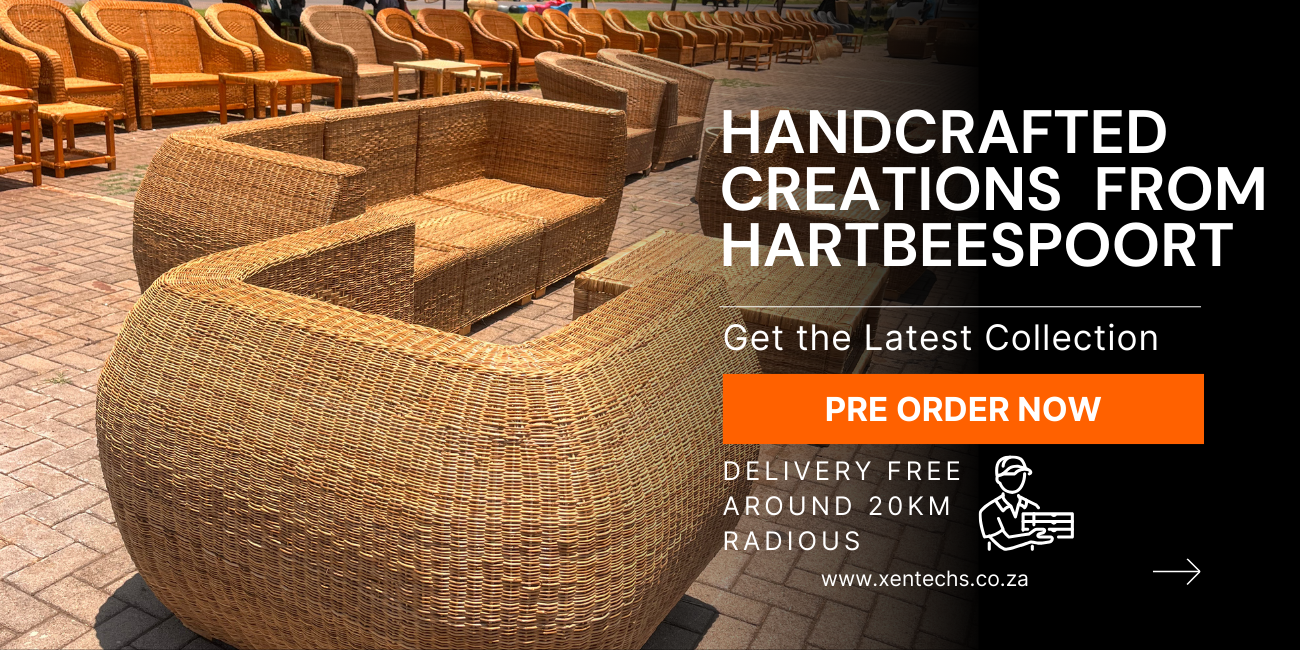
Welcoming Our First Artisan Seller to Xentechs: Handcrafted Creations from Hartbeespoort


From Expensive Ads to Smart Influencers: Discover Cost-Effective Marketing Strategies Today!


At Xentechs, we believe that every individual in Africa should have the opportunity to shop with ease, diversity, and reliability. Our platform is more than just an online shopping destination; it is a vibrant community that celebrates the rich, cultural tapestry of Africa, one shop at a time. We aim to connect Africa by bridging the gap between local sellers and global consumers, making shopping in Africa an accessible and exciting experience.


