
They Built in Stone Without Mortar.
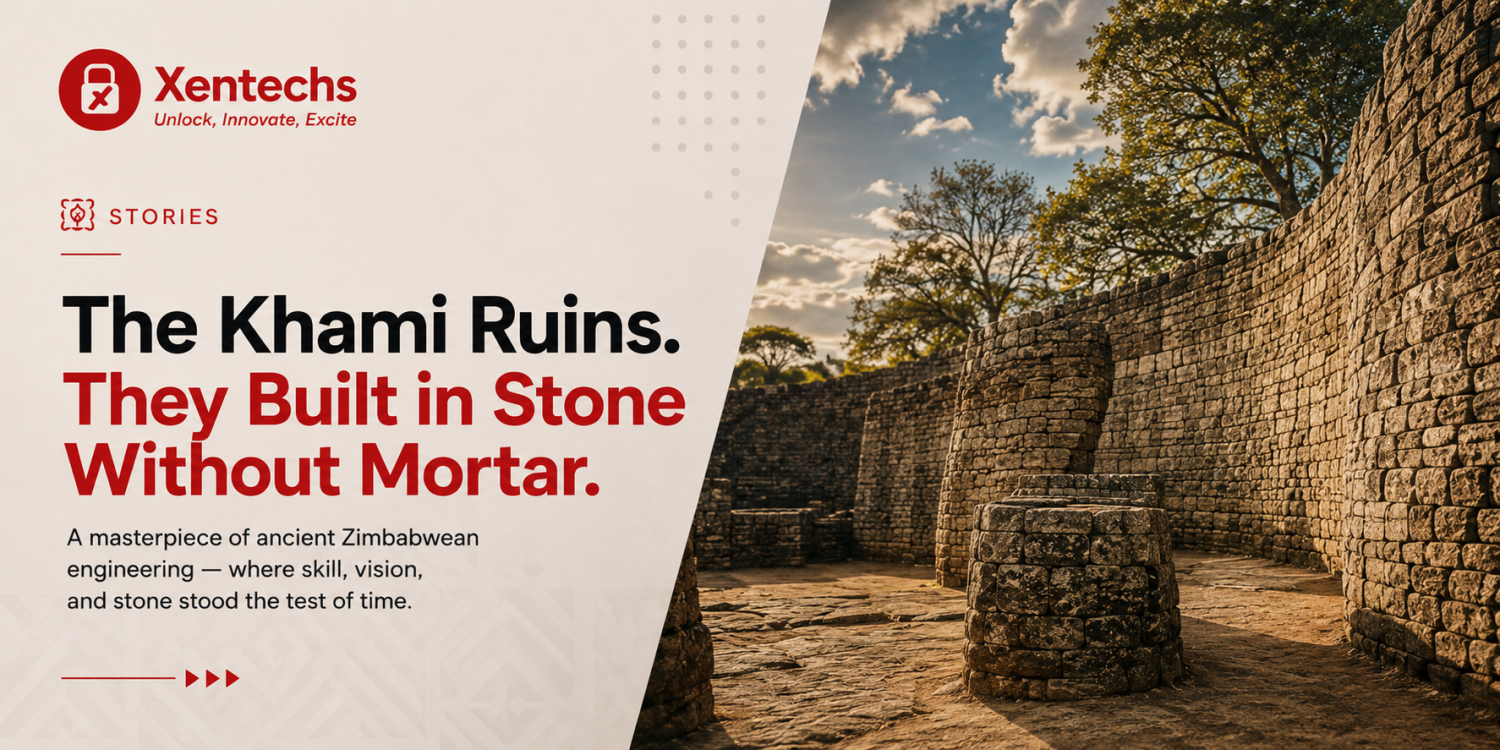
Twenty-two kilometres west of Bulawayo, on a granite hilltop overlooking the Khami River, there are walls that have been standing for six hundred years. They were built without mortar. No cement, no lime, no binding agent of any kind. Just stone fitted to stone with a precision so exact that the structures have survived six centuries of rain, heat, political upheaval, colonial conquest, and deliberate neglect — and they are still standing.
The civilisation that built them is not well known. It should be.
The Torwa dynasty — the builders of the Khami Ruins, capital of the Kingdom of Butua — raised one of the most sophisticated societies in 15th-century Africa. They traded in gold with Portuguese merchants on the Mozambican coast and in Chinese porcelain from the Ming Dynasty. They developed a unique architectural style that improved on everything their predecessors had built. They embedded geometric patterns — chevrons, herringbones, checkerboards — into their walls not as decoration but as declarations of identity, status, and power. And when they were finally displaced, the civilisation that conquered them looked at what they had built and chose to continue it rather than destroy it.
This is that story.
"Standing amid the ruins, I felt a mix of pride and longing. Pride in the ingenuity of African ancestors who carved complex societies into stone; longing because these stories are rarely foregrounded in our educational and cultural consciousness."
— Archie Mathibela, Whispers in Stone, 2025
The World Before Khami
To understand the Torwa dynasty, you must first understand Great Zimbabwe — the civilisation they succeeded and the architectural tradition they inherited.
Great Zimbabwe between 1300 and 1500 AD was the largest settlement in sub-Saharan Africa, its wealth founded on the cattle and gold trade down the Sabi River with Swahili merchants on the Indian Ocean coast. At its height it housed tens of thousands of people, controlled trade routes across southern Africa, and produced the monumental dry-stone enclosures that still stand today as the largest ancient stone structures south of the Sahara.
But around 1450 AD, for reasons that historians still debate — environmental pressure, political fragmentation, the exhaustion of local resources — the Great Zimbabwe Kingdom began to decline. Power fractured. Different Shona groups moved in different directions, carrying the knowledge of dry-stone construction with them.
The Torwa went west.
It has been suggested that the Torwa were rebels or outsiders of the Kingdom of Mutapa who, at the end of the 15th century, decided to break away and establish a new kingdom. They settled in the territory between the Zambezi and Limpopo rivers — what is now southwestern Zimbabwe and northeastern Botswana — and they chose as their capital a granite hilltop above the Khami River.
Then they began to build.
Great Zimbabwe — the architectural predecessor that the Torwa dynasty inherited, improved, and carried westward to build Khami
The Architecture — Better Than What Came Before
The builders of Khami did not simply copy Great Zimbabwe. They improved on it in ways that reflect a sophisticated understanding of engineering, environment, and aesthetics.
At Great Zimbabwe, the famous stone enclosures are free-standing walls — impressive in their scale and precision, but essentially vertical structures built on relatively flat ground. Unlike Great Zimbabwe which was built on flat ground, Khami's builders chose to construct on natural granite hills, incorporating the landscape into their architecture. This was not a limitation. It was a deliberate choice that gave the settlement both natural defensive advantage and a dramatic visual presence that could be seen — and understood as a statement of power — from a great distance.
The technical innovation at Khami was the platform. Rather than free-standing enclosures, the principal features of Khami's architectural style are stone walls which are in-filled to create levelled platforms, or terraces. These raised surfaces — some rising between two and seven metres above the ground — carried the elite residences of the Torwa ruling class. The king's residence, called the Mambo, sat at the highest point of the Hill Complex, on a platform elevated above all others. Social hierarchy was literally built into the landscape.
How They Built Without Mortar
Unlike at Great Zimbabwe, some of the walls at Khami have foundations built with huge blocks which would have been lifted by at least four people. The complex was first built up by creating terraces of rough walling. These stable walls were then covered up by quality walling of dressed stone blocks. The terraces leaned inwards so that gravity would not cause collapses — an engineering principle that required no formal education to discover, only generations of accumulated knowledge and a deep understanding of how stone behaves under its own weight. Six centuries later the walls are still standing. The principle worked.
The decorative work at Khami surpassed anything previously seen in the Zimbabwe Culture tradition. Some sections bear intricate patterns — chevrons, herringbones, and checkered motifs — that reflect aesthetic sensibility and possibly spiritual symbolism. These were not applied after the fact. They were built into the walls as they were constructed — requiring the stonemason to plan the pattern from the very first stone laid, holding the entire design in his mind as he worked.
The most celebrated of these is the Checkered Wall — alternating blocks of light and dark stone creating a pattern so visually striking that it has become the defining visual emblem of the Khami site. Recent excavations between 2000 and 2006 have revealed that the walls of the western parts of the Hill Complex were all decorated in chequer, herringbone, cord, as well as variegated stone blocks. The decoration was not limited to the most visible walls. It was everywhere — an assertion that the Torwa surrounded themselves with beauty as a matter of principle, not performance.
Khami Ruins — the decorated dry-stone walls of the Torwa dynasty · Bulawayo, Zimbabwe · UNESCO World Heritage Site inscribed 1986
The Trade Empire — China, Portugal, and the Indian Ocean
The Torwa were not an isolated civilisation building in the wilderness. They were active participants in one of the most sophisticated long-distance trade networks in the pre-colonial world — a network that connected the interior of Africa to the Indian Ocean coast, and through that coast to Arabia, India, and China.
The evidence sits in display cases at the Natural History Museum in Bulawayo today. Archaeological evidence for the Torwa's involvement in the Indian Ocean trade includes a diverse range of imported objects unearthed at Khami: 15th and 17th century Spanish porcelain, Rhineland stoneware, and Chinese porcelain from the Ming Dynasty. Think about what that means. While the Torwa were building their decorated stone walls on a hilltop in what is now Zimbabwe, they were simultaneously acquiring ceramics made for Chinese emperors — objects that had travelled overland and by sea for thousands of kilometres before ending up in a royal enclosure in southern Africa.
"The ruins are not places of defence, but were prestige buildings designed to demonstrate Torwa wealth."
— Zimbabwe Field Guide · Khami UNESCO World Heritage Site
In exchange for what they received, the Torwa exported the commodities that had made Great Zimbabwe wealthy before them. The Torwa elite controlled the rich grazing lands and gold, copper and salt mines of Matabeleland and adjacent Botswana. The gold trade, although diminished, still existed. They were mining. They were smelting. They were producing finished craft objects in metal that were traded along routes stretching to the coast.
Imported to Khami Origin What It Tells Us
Ming Dynasty porcelain China Active participation in Indian Ocean trade routes connecting Africa to Asia
Spanish ceramics Europe — 15th–17th century Contact with Portuguese trade networks operating from the Mozambican coast
Rhineland stoneware Germany European goods reaching the interior of Africa through Arab-Swahili intermediaries
Glass beads Various — India, Middle East Multi-continental trade relationships established over generations
The Craft Traditions — What the Walls Do Not Show
The stone walls are the most visible evidence of Torwa civilisation. But they were not the only craft tradition the Torwa sustained.
Inside the stone enclosures, the population lived in daga huts — structures built from clay and mud, shaped and decorated by hand, forming the intimate domestic spaces where daily life was conducted. These were not crude shelters. They were sophisticated clay constructions that required knowledge of material behaviour, structural load, and surface decoration passed across generations.
The Torwa were also metalworkers. The gold they exported was not raw ore dug from the ground and shipped directly. It was processed — smelted, worked, and shaped by craftspeople who understood the material at a level that could only have been achieved through decades of accumulated technique. The gold objects produced in and around Khami during the Torwa period represent some of the most technically accomplished metalwork in 15th-century southern Africa.
The word Zimbabwe itself — from which the modern nation takes its name — comes from the Shona dzimba dze mabwe, meaning "houses of stone." The Torwa dynasty, as direct inheritors of the Zimbabwe Culture tradition, were among the last and most sophisticated practitioners of this house-building art before it was lost entirely. In the 1830s successive invasions of groups fleeing the military campaigns of the Mfecane in South Africa brought the Rozwi to a close. The migrant Ndebele absorbed the local people and a new way of life became dominant — the art of dry stonewalling was lost and former settlements were abandoned and left to decay.
The Fall — And What Was Lost
The Torwa dynasty at Khami lasted approximately 233 years — from around 1450 to 1683. Their fall came not from external conquest alone but from internal fracture first.
In the 1640s, a political dispute occurred amongst the Torwa rulers. A power struggle and civil war ensued, and the defeated party was forced to flee. The weakened state that emerged from this internal conflict was vulnerable in a way it had not been before. The Rozwi dynasty — a successor group with its own military ambitions — saw the opening.
Khami rose into significance from AD 1450 to 1683 and its influence extended deep into the Kalahari of Botswana. This ultimately led to the invasion by the Rozwi sometime before 1683. They did not however dismantle the settlement but instead built on it, in some cases building even grander settlements. This is a telling detail. The Rozwi, who conquered Khami, recognised what they had captured — not just territory but a tradition of building that was worth continuing. They inherited the architectural knowledge and used it to build their own capital at Danangombe, sometimes called the most beautifully decorated of all the Zimbabwe Culture sites.
The tradition finally ended in the 1830s, when the disruptions of the Mfecane — the massive population movements triggered by the rise of the Zulu Kingdom in South Africa — sent waves of refugees northward into Zimbabwe. The Ndebele, one of the groups displaced northward during this period, absorbed the local populations and established their own settlement patterns. The art of dry-stone walling, no longer practised, no longer taught, disappeared from living knowledge.
What remained were the walls.
What UNESCO Recognised — And Why It Matters
Khami was inscribed as a UNESCO World Heritage Site in 1986 for its outstanding universal value as an example of innovative dry-stone walling techniques and its evidence of extensive international trade networks. It is Zimbabwe's second UNESCO World Heritage Site, after Great Zimbabwe itself.
But recognition from UNESCO is not the same as recognition in the broader cultural consciousness. Khame Ruins are perhaps the least known of Zimbabwe's five World Heritage sites. The story of the Torwa dynasty — their architectural innovation, their trade networks, their craft traditions, their sophisticated social organisation — is not widely taught. Not in Zimbabwe. Not in South Africa. Not anywhere in the world that matters to the people whose heritage this is.
The Khami Ruins are not a tourist attraction. They are a proof of concept. They prove that African civilisations were building sophisticated, beautiful, internationally connected societies at the same time that European nations were emerging from the Middle Ages. The stone walls that have stood for six hundred years without mortar are the most durable argument against the lie that Africa had no history worth knowing.
The Connection to Common Moyo — And to Xentech
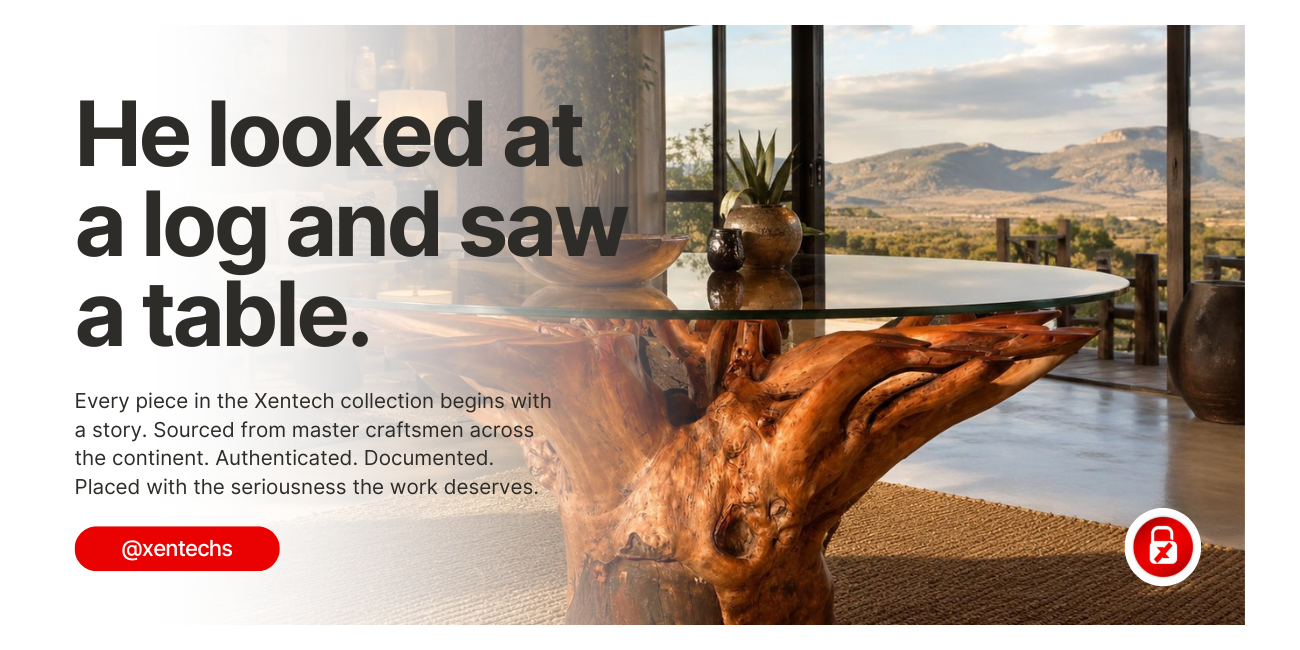
Common Moyo — the Zimbabwean craftsman whose root table you have seen on this platform — looked at a log and saw a crocodile. He picked it up, shaped what he saw inside it, and sold it on the first day.
The builders of Khami looked at a granite hillside and saw a palace. They picked up stone after stone, shaped platforms and terraces and decorated enclosures without a single sketch or blueprint, and built something that has survived for six centuries.
These are not separate stories. They are the same story — the story of what African hands have always been capable of when given the materials, the knowledge, and the freedom to build. The Torwa built it in stone. Common Moyo builds it in wood. The tradition runs in a direct line from the hilltop above the Khami River to a workshop in Hartebeespoort.
Xentech carries both.
Zimbabwean Craft in the Xentech Collection
The Xentech collection carries authenticated Zimbabwean craft pieces — including Shona stone sculptures, wooden carvings, and bespoke pieces by Common Moyo — each documented with full cultural provenance tracing the unbroken line from the Zimbabwe Culture tradition to the present day. Every piece carries the heritage of the civilisation that built Khami.
Explore the Collection
What the Walls Are Saying
The chevrons and herringbones and checkerboard patterns built into the walls of Khami were not random. They were identity — a visual language that said: We were here. We built this. We knew what we were doing.
Six hundred years later, the walls are still saying it.
The question is whether we are listening carefully enough to hear what they are telling us — about the sophistication of African civilisation, about the depth of African craft tradition, about the unbroken line between the stone-builders of Butua and the wood-carvers of today.
Xentech is listening. And we are here to make sure the rest of the world listens too.
To enquire about Zimbabwean pieces in the Xentech collection, to discuss a CSI acquisition rooted in Zimbabwean heritage, or to commission a bespoke piece from Common Moyo: info@xentechs.co.za · WhatsApp 078 376 7616 · xentechs.co.za
Recent Posts




Welcoming Our First Artisan Seller to Xentechs: Handcrafted Creations from Hartbeespoort


From Expensive Ads to Smart Influencers: Discover Cost-Effective Marketing Strategies Today!


At Xentechs, we believe that every individual in Africa should have the opportunity to shop with ease, diversity, and reliability. Our platform is more than just an online shopping destination; it is a vibrant community that celebrates the rich, cultural tapestry of Africa, one shop at a time. We aim to connect Africa by bridging the gap between local sellers and global consumers, making shopping in Africa an accessible and exciting experience.


