
The Kingdom That Invented Geometry.

There is a moment in the history of modern art that most people do not know about. It happened in Paris, sometime in the early twentieth century, in the studio of Henri Matisse. The artist had pinned a collection of African textiles across his studio walls — woven from raffia palm fibre, patterned in geometric designs so complex and so precise that Matisse could spend hours simply looking at them. He described this practice in letters to his sister. He would wait, he wrote, for something to come to him.
What came to him became some of the most significant art of the modern era — the cut-out collages of his final years, including the 1951 work Snow Flowers, held today in the Metropolitan Museum of Art in New York. The allover patterning, the abstract geometric forms floating free of background — these were the direct inheritance of those studio walls.
The textiles on those walls came from the Kuba Kingdom. And almost nobody in the mainstream art world has ever said so with the directness the fact deserves.
"Matisse owned several Kuba cloths from Central Africa. After hanging panels of the Kuba textiles across his studio walls, Matisse wrote in letters to his sister that he often looked at them for long periods, waiting for something to come to him."
— The Metropolitan Museum of Art
Who Were the Kuba?
The Kuba Kingdom — also known as the Kingdom of the Bakuba or Bushongo — emerged in what is now the southeastern region of the Democratic Republic of the Congo, in the territories between the Sankuru, Lulua, and Kasai Rivers. Between the 17th and early 20th centuries, it was one of Africa's largest and most powerful societies, controlling trade in ivory and rubber across a vast region of Central Africa.
This was not a small or peripheral culture. At its apex in the mid-19th century, the Kuba Kingdom was a sophisticated political, economic, and artistic civilisation with a complex royal court, a system of tribute taxation, and a cultural philosophy so deeply committed to design and ornamentation that it permeated every aspect of life — from the clothes on a person's back to the cup they drank from.
The Kuba Kingdom's wealth allowed it to resist colonisation longer than most other regions of the Belgian Congo — where King Leopold II's exploitation of rubber resulted in catastrophic destruction across the territory. The Kuba kings maintained their sovereignty and their artistic traditions longer than almost any of their neighbours.
Their 93rd king, Shamba Bolongongo, who ruled around 1600, is credited in oral history with introducing weaving and textile manufacture to his people. He was also the first Kuba ruler to commission his portrait in wood — establishing a tradition of royal ndop sculptures that became one of the most distinctive art forms in the entire African canon. These were not realistic portraits made from observation. They were ideal representations — each king identified by a small personal emblem and a distinctive geometric pattern chosen at the moment of his installation as ruler.
Design, in other words, was identity. It was also power.
Ndop royal portrait sculpture, Kuba Kingdom · Democratic Republic of Congo · Each king identified by a unique geometric pattern at the base
The Design Philosophy That Changed Everything
The Kuba did not have a word for art. But they had a word for design.
That word was bwiin — and it was foundational to Kuba society in a way that has no direct equivalent in Western cultural frameworks. Almost all manufactured objects in the Kuba Kingdom were elaborately decorated. The intricacy with which a person's possessions were adorned reflected their status and indicated their social class. The more complex the design, the greater its economic and aesthetic value, and the more powerful its function as a status symbol or royal emblem.
"The Kuba do not have a word for art… but they have one for design. Design — or Bwiin — is foundational to Kuba society. Almost all manufactured objects are elaborately decorated."
— Elizabeth Bennett and Niangi Batulukisi, Kuba Textiles & Design
This was not decoration for decoration's sake. Every geometric pattern in the Kuba visual vocabulary carried meaning — representing elements of nature, spiritual relationships, social hierarchy, and the history of the kingdom itself. The patterns spoke of cultivated land and its importance, the connection with spirits and ancestors, wisdom, fertility, vital energy, the cycle of life, renewal, and constant movement.
In 2004, a Canadian collaborative study by computer scientists and mathematicians examined Kuba textile design using digital analysis tools. What they found was extraordinary. The Kuba designs displayed fractal symmetry — including recursion, scaling, self-similarity, and fractal dimension — achieved through juxtapositions of linear embroidery, velvet forms, and contrasting colour. The mathematical complexity embedded in these hand-made textiles was not accidental. It was the product of a civilisation that had developed its own numerical and geometric systems and encoded them into cloth.
The Making of Kuba Cloth
The production of Kuba textiles was a community enterprise divided with precision between men and women, each role essential to the final product.
The men cultivated the raffia palm and wove its fibres into base cloths — thin textiles for ceremonial embroidery, thicker ones for everyday use. The raffia palm had been present in Central African life for over a thousand years; archaeologists have found raffia seeds in sites dating to the 4th century AD.
The women then took the base cloths and applied their embroidery — the geometric patterns that made Kuba textiles famous across the world. The most prized of these, the Kasai Velvet panels, were created using a technique in which the embroidered loops were cut to create a pile surface with the texture and appearance of velvet. The result was a cloth so extraordinary in its tactile and visual complexity that European collectors were astonished when they first encountered it at an African art exhibition in Brussels in the late 1800s.
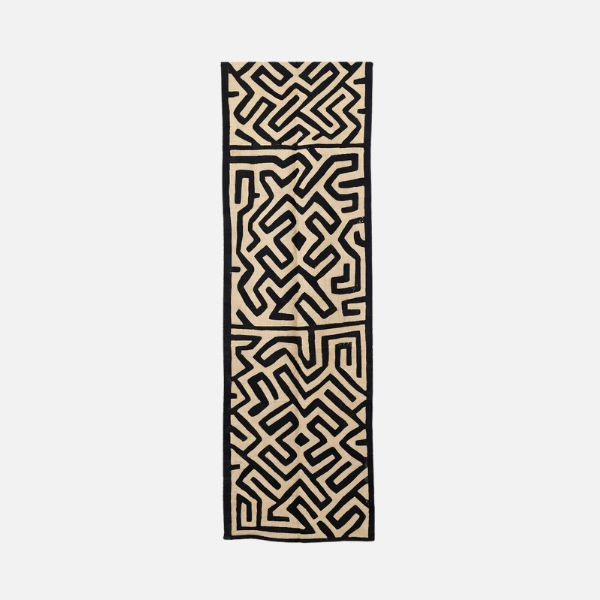
Kuba raffia textile with geometric embroidery · Democratic Republic of Congo · 19th–20th Century · The geometric complexity of each panel reflects the status and wealth of its owner
As early as the 17th century, the Kuba royal government collected textiles as a form of tribute tax — building a royal treasury of extraordinary cloth that represented the wealth and power of the kingdom. The most complex panels could only be worn by royalty. They were not simply clothing. They were declarations.
The Masks of the Kuba
If the textiles are the Kuba's most intimate art form — worn on the body, carried in the hands — then the masks are their most dramatic. The Kuba are known across the world for their monumental helmet masks, featuring the same exquisite geometric patterns found in the textiles but now rendered in carved wood, adorned with fabrics, seeds, beads, and shells.
Three royal masks dominate the Kuba ceremonial repertoire. The Mukenga mask represents the kingdom's founding ancestor Woot and is worn only by royalty. The Ngaady a Mwaash mask represents a female figure — the sister and wife of Woot — and is characterised by delicate painted lines and beaded ornamentation. The Bwoom mask represents a rival to the royal line, and its appearance in ceremony carries a narrative of political tension that the Kuba have encoded into ritual performance for centuries.
These are not decorative objects. They are dramatic characters in an ongoing story about power, origin, and identity — a story the Kuba have been telling through their art since before European contact.
Kuba ceremonial mask · Democratic Republic of Congo · Beads, raffia, shells, and carved wood · Each mask carries a specific ceremonial role in Kuba royal performance
The Kuba polychrome ceremonial mask available in the Xentech collection — priced at R4,500 — carries this tradition into your hands. It is not a reproduction. It is a continuation of a visual language that has been refined across centuries, made by craftspeople who understand its meaning and honour its responsibility.
The Matisse Connection — And Why It Matters
Henri Matisse was not a casual admirer of African art. He owned multiple Kuba cloths from Central Africa, acquired through the early African art exhibitions in Paris that he attended in the early 20th century. These textiles remained in his collection until his death.
The influence was direct, documented, and transformative. Matisse's final major works — the cut-out paper collages created in the last decade of his life — bear the unmistakable inheritance of Kuba design philosophy. The allover patterning. The geometric abstraction. The way form floats free of conventional perspectival space. These are not European inventions. They are Kuba innovations, filtered through a French master's sensibility and presented to the world as modernism.
Matisse was not alone. Pablo Picasso's African period — which produced Les Demoiselles d'Avignon in 1907, widely regarded as the founding work of Cubism — was directly sparked by African art. The Cubist movement that followed, with its deconstruction of form and its rejection of Western conventions of space and proportion, echoes the geometric fragmentation that Kuba artists had been practising for generations.
"The bold geometric pattern seen in Matisse's Red Interior still life on a blue table is similar to the Kuba cloth, an African handwoven fabric by the Kuba people of Congo."
— Metropolitan Museum of Art
The art world has spent a century celebrating these modernist innovations while rarely acknowledging their source. The Kuba Kingdom did not borrow from European modernism. European modernism borrowed from the Kuba Kingdom. The credit has simply been slow to travel in the right direction.
The Kuba Kingdom Today
The Kuba Kingdom still exists. Its royal court continues in the Democratic Republic of the Congo, and its craft traditions — the textile weaving, the mask carving, the geometric design philosophy — are still practised by living craftspeople who understand what they are making and why it matters.
The global market for Kuba art has been growing steadily. Major museums — the Brooklyn Museum, the Metropolitan Museum of Art, the Baltimore Museum of Art, the British Museum — hold significant Kuba collections. A 2018 exhibition at the Baltimore Museum of Art titled Kuba: Fabric of an Empire drew significant critical attention and renewed international interest in the kingdom's artistic legacy.
What has been slower to develop is a market that connects serious buyers directly to authenticated Kuba pieces — with full documentation, cultural context, and the kind of provenance infrastructure that makes a corporate acquisition defensible, a private purchase meaningful, and a lodge installation genuinely educational for the guests who encounter it.
That is precisely the gap Xentech was built to fill.
Kuba Kingdom Pieces in the Xentech Collection
Xentech carries authenticated Kuba Kingdom pieces across multiple categories — from the polychrome ceremonial mask at R4,500 to the Kuba Kingdom Raffia Panel at R1,850 and the Maze Runner Table Runner at R1,850. Every piece comes with full cultural documentation, provenance certification, and the story that makes it worth far more than its price.
View the Collection
Why This Matters Now
The story of the Kuba Kingdom is not a story about the past. It is a story about what happens when a civilisation takes design seriously — when it builds a philosophy, a language, and an economy around the act of making beautiful and meaningful things.
Africa is not short of that kind of civilisation. What it has been short of is a market that treats its cultural output with the seriousness it deserves — that documents it, authenticates it, prices it fairly, and places it in the hands of people who understand what they are holding.
When you own a piece from the Kuba Kingdom, you are not buying decoration. You are buying a geometric language that mathematicians have studied, that Matisse hung on his studio walls waiting for inspiration, and that a civilisation spent four centuries perfecting in the rainforests of Central Africa.
You are buying one of the most sophisticated design traditions in the history of human civilisation.
And it deserves to be in your collection.
Xentech exists to preserve African culture by making it economically irresistible. The Kuba Kingdom is one of the most compelling arguments for why that mission matters. Enquire about Kuba Kingdom pieces in the Xentech collection at info@xentechs.co.za or WhatsApp 078 376 7616.
Recent Posts

Welcoming Our First Artisan Seller to Xentechs: Handcrafted Creations from Hartbeespoort


From Expensive Ads to Smart Influencers: Discover Cost-Effective Marketing Strategies Today!


At Xentechs, we believe that every individual in Africa should have the opportunity to shop with ease, diversity, and reliability. Our platform is more than just an online shopping destination; it is a vibrant community that celebrates the rich, cultural tapestry of Africa, one shop at a time. We aim to connect Africa by bridging the gap between local sellers and global consumers, making shopping in Africa an accessible and exciting experience.


